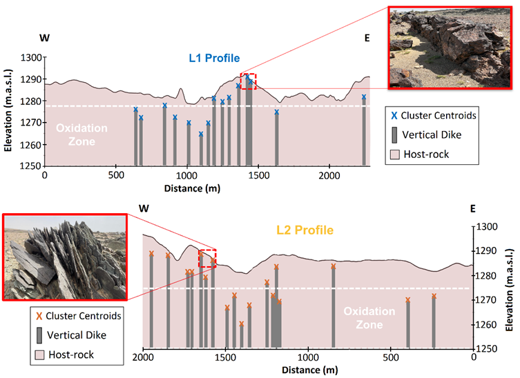
At a volcanogenic massive sulphide system TDS developed and applied three advances that reduce interpretation uncertainty. Machine-learning-assisted magnetic source identification combines Euler deconvolution with unsupervised clustering (K-means and a hybrid DBSCAN/K-means framework) to replace scattered, subjective solutions with well-located near-vertical mineralised bodies. Laboratory magnetic-susceptibility measurements on fresh massive sulphide, transitional and oxidised material tie the ground magnetic response to lithology, alteration and mineralisation. Transient-electromagnetic inversion that includes induced-polarisation parameters, supported by laboratory spectral IP and geochemistry, corrects the distortion that highly conductive, polarisable sulphides impose on conventional resistivity-only inversion. The three are combined with geological mapping, boreholes and geochemistry into 2D and 3D models.
Integrated Hard-Rock Lithium Exploration: Drone and Ground Geophysics, Laboratory Analysis and AI
Arabian Shield, Saudi Arabia
An ongoing exploration programme for lithium-bearing pegmatites that goes beyond anomaly picking to an understanding of the rocks themselves.