
Natural Hydrogen Exploration: Integrated Geophysics, Geochemistry and AI-Assisted Modelling
North-western Greece · Arabian-Nubian Shield (Saudi Arabia, Egypt, Oman, United Arab Emirates)
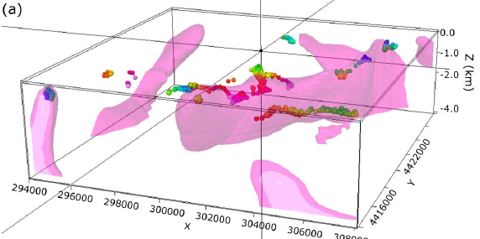
TDS works on how natural hydrogen is generated, migrates and accumulates, with a focus on ophiolitic and ultramafic rocks where serpentinisation produces hydrogen through water-rock reaction. In north-western Greece, aeromagnetic and gravity data, advanced magnetic processing, Euler deconvolution, structural interpretation and gas geochemistry were combined to link ultramafic bodies imaged to about 4 km depth with deep-rooted faults and active gas seeps, where measurable hydrogen occurs within methane-dominated emissions. Building on that case, TDS is developing a transferable, physics-based workflow for the Arabian-Nubian Shield that joins remote sensing and AI-assisted structural mapping with gravity, magnetic, electromagnetic and magnetotelluric surveys, field hydrogen measurements and laboratory petrophysics in constrained 3D models of source, pathway, reservoir and seal.
Outcome: exploration targeting based on the whole hydrogen system rather than surface gas observations alone, and 3D models that rank priority investigation and drilling locations across the region.
Related Projects